


Global audience
Updated 2025
A practical framework to choose the right PTFE washer—grade, geometry, compliance, and verification—backed by test methods and field‑proven checks.
Step 1 — Define the job the washer must do
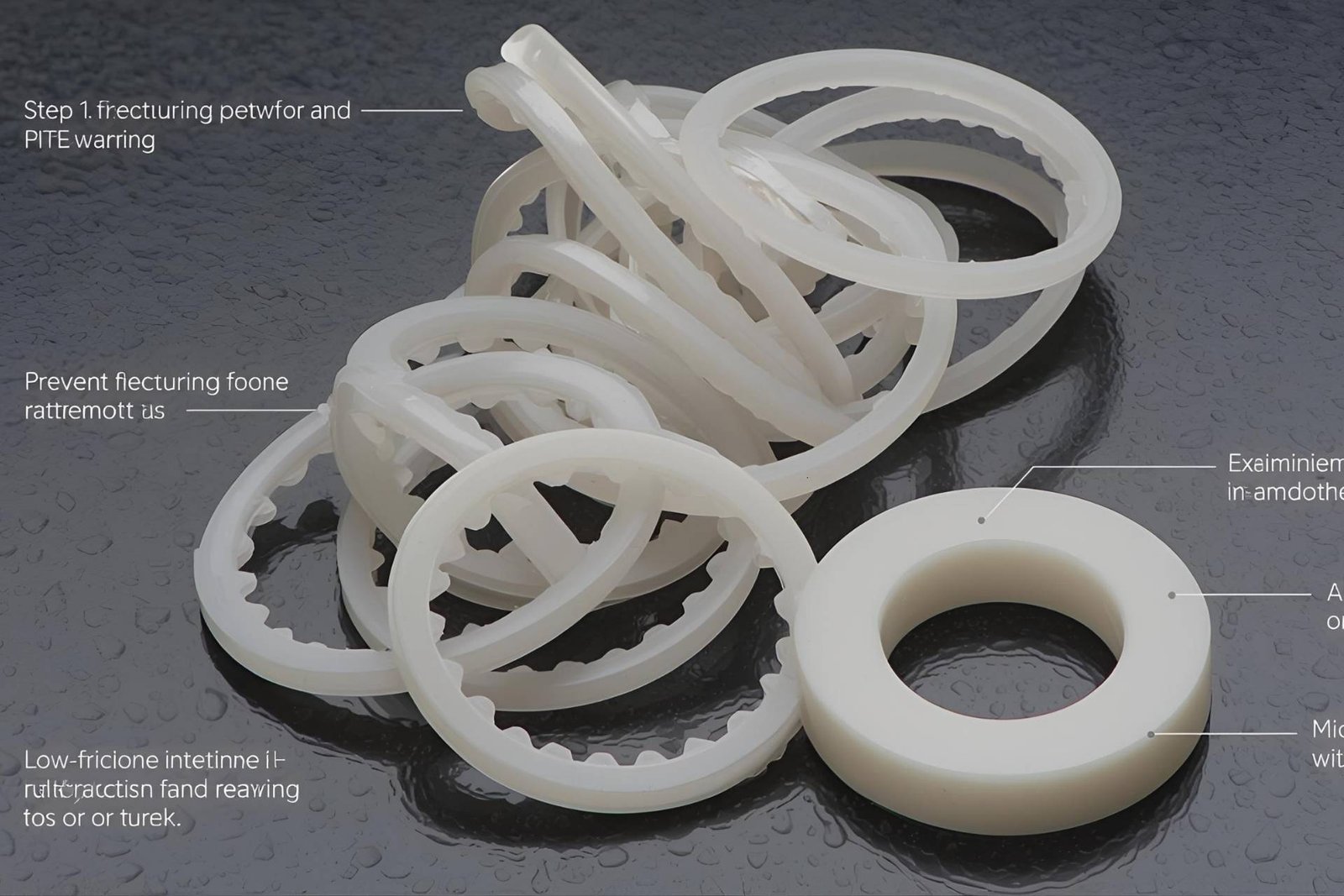
- Isolation: prevent galvanic coupling and provide dielectric spacing between dissimilar metals or electronics.
- Chemical barrier: resist aggressive media where elastomers or nylons fail.
- Low‑friction interface: allow controlled slip at joints or fixtures.
- Micro‑sealing: assist face sealing on smooth flanges (note: not a substitute for gaskets with elastic recovery).
Target clamp load and face flatness?
Regulatory constraints (FDA/EU)?
Electrical isolation requirements?
Step 2 — Match the PTFE grade to the duty
| Use case | Recommended grade | Why it fits | Watch‑outs |
|---|---|---|---|
| Sanitary/food equipment, lab gear | Virgin PTFE (natural white) | Highest chemical purity; smooth, cleanable surface; FDA pathway | Greater creep; design for larger bearing area |
| High preload, torque retention | Glass‑filled PTFE 15–25% | Higher modulus lowers cold flow | More abrasive; consider polished backup hardware |
| Semi‑dynamic or heat‑loaded joints | Carbon/graphite‑filled PTFE | Improved wear and thermal conductivity | Dielectric properties change; darker color |
| Heavy clamps/bearing pads | Bronze‑filled PTFE 40–60% | High compressive strength; better heat spreading | Narrower chemical resistance vs. virgin |
| Leak‑tight cycling flange | PTFE‑jacketed elastomer washer | PTFE chemical face with elastic core recovery | Core limits max temperature; higher cost |
Engineering support and custom blends are available from SPARTA SEALING. Company capabilities are outlined on the seal company page.
Step 3 — Size the geometry for pressure and stability
Starting dimensions
- Thickness: 1.0–3.0 mm for M6–M16; 4–5 mm if surfaces are uneven or isolation gap is required.
- OD/ID ratio: ≥1.8 for virgin PTFE under high preload; ≥1.5 with filled grades or steel backup.
- Edge: specify a 0.2–0.5 mm radius to prevent extrusion lips.
Design pressure target
- Keep sustained contact pressure for virgin PTFE around 30–40 MPa; filled grades tolerate more.
- If calculated P = F/A is high, increase OD or choose a filled grade; avoid simply “tightening more.”
- For rough faces (Ra > 3.2 μm) use a jacketed washer or add a compliant layer to improve micro‑sealing.
Step 4 — Select mating hardware and surface prep
- Use a stainless or coated steel backup washer on the nut/bolt side to improve torque retention and distribute load.
- Prefer polished hardware faces; avoid sharp edges that can cut into PTFE.
- Remove burrs and contamination from flange faces; achieve Ra ≤ 3.2 μm where possible.
- For electrical isolation, add non‑conductive sleeves or bushings to prevent current bypassing the PTFE washer.
Step 5 — Verify compliance and documentation
| Requirement | What to request | Why it matters |
|---|---|---|
| Material identity | Certificate of conformity with resin grade and filler percentage | Ensures repeatability and legal traceability |
| Food contact (if applicable) | FDA 21 CFR 177.1550 / EU 10/2011 statements for virgin PTFE | Enables sanitary deployment |
| Dimensions | OD/ID ±0.2–0.3 mm; thickness ±0.05–0.10 mm for skived parts | Controls load distribution and leakage risk |
| Electrical isolation | Dielectric strength or volume resistivity data (ASTM D149/D257) | Confirms insulation performance |
| Thermal endurance | Continuous service temperature ratings and sintering profile | Supports temperature derating decisions |
Step 6 — Costing and lifecycle trade‑offs
| Scenario | Grade | Indicative unit price (M10) | Service comment |
|---|---|---|---|
| Sanitary isolation on stainless | Virgin PTFE | $0.25–$0.80 | Document compliance; increase OD for torque |
| High preload with retorque control | Glass‑filled PTFE 15–25% | $0.40–$1.10 | Backup washer recommended |
| Hot clamps or minor sliding | Carbon/graphite‑filled | $0.50–$1.30 | Improved wear and thermal path |
| Heavy clamp/bearing behavior | Bronze‑filled 40–60% | $0.60–$1.50 | Check media compatibility |
| Leak‑tight cycling flange | PTFE‑jacketed elastomer | $1.20–$3.50 | Core sets temperature limits |
| Prices reflect 2024–2025 industrial catalogs; confirm quotes for volume and tolerances. | |||
Step 7 — Installation and validation checklist
- Clean faces; verify flatness and remove burrs.
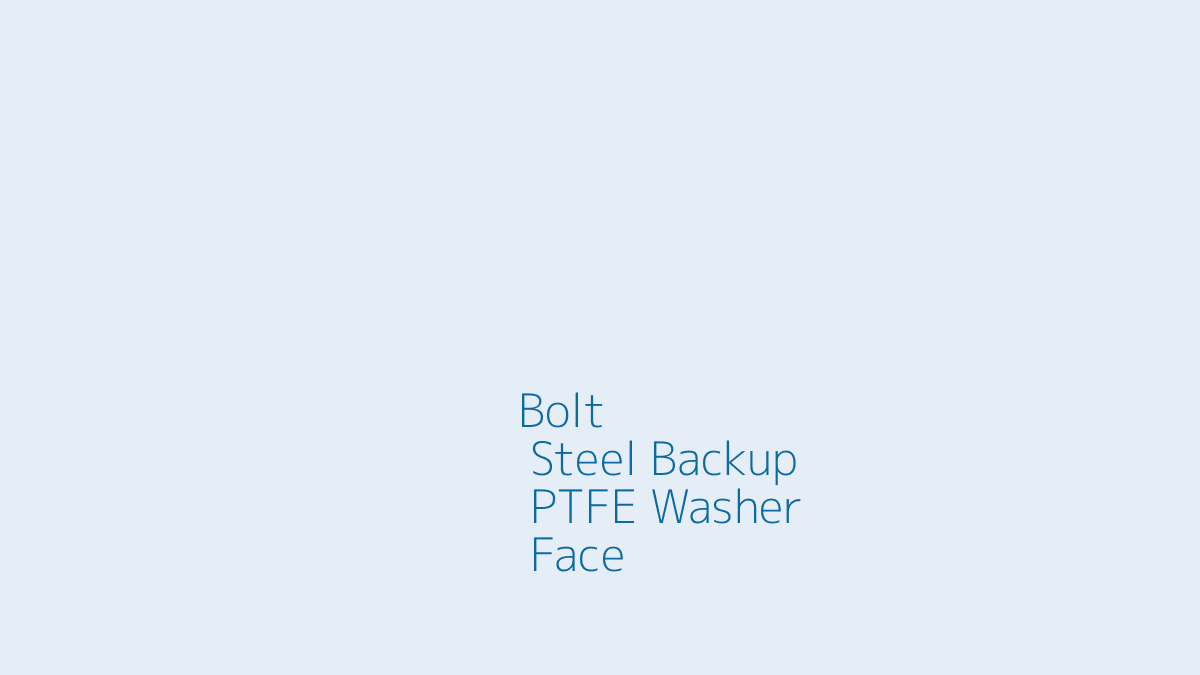
- Stack order: steel backup washer (nut/bolt side) → PTFE washer → mating face. Add sleeves if isolation is required through the bolt.
- Tighten in stages with cross‑pattern where applicable; avoid impact tools that overshoot preload.
- Measure clamp (bolt stretch or torque‑angle) for critical joints.
- Retorque after first thermal cycle (or 24–48 hours) to counter creep relaxation.
- Document final torque and inspection intervals in the maintenance plan.
Data panel — properties that drive selection
| Property | Virgin PTFE | Filled PTFE (typical) | Standards/examples |
|---|---|---|---|
| Density | 2.13–2.20 g/cm³ | Up to ~3.1 g/cm³ (bronze) | ASTM D792 |
| Tensile strength | 20–35 MPa | 15–30 MPa | ASTM D638 |
| Elongation at break | 200–400% | 50–200% | ASTM D638 |
| Hardness | Shore D 50–60 | 55–70 | ASTM D2240 |
| Thermal conductivity | ~0.25 W/m·K | 0.5–1.5 W/m·K | ASTM E1530 |
| Coefficient of friction vs. steel | 0.05–0.10 | 0.08–0.20 | ASTM D1894 (analogous) |
| Dielectric strength | 60–100 kV/mm | 50–90 kV/mm | ASTM D149 |
| Water absorption (24 h) | <0.01% | <0.01% | ASTM D570 |
Visual reference — washer placement
Supplier engagement — questions to ask
- What is the resin grade and filler percentage? Provide a certificate for every lot.
- How is thickness controlled (skived sheet vs. molded)? What tolerances are standard?
- What is the sintering/annealing profile, and how is creep tested (ASTM F38, where applicable)?
- Can sleeves and bushes be supplied for full electrical isolation of the joint?
- What packaging is used to prevent warping and contamination?
For custom dimensions, rapid prototypes, and technical support, contact SPARTA SEALING—a specialized seal company offering design‑to‑delivery services.
Frequently asked questions
References and attribution
- ASTM standards: D4894/D4895 (PTFE resins), D638 (tensile), D2240 (hardness), D792 (density), D149 (dielectric), D570 (water absorption), F38 (creep relaxation) — https://www.astm.org/
- ISO plastics and tribology references — https://www.iso.org/
- FDA 21 CFR 177.1550 — perfluorocarbon resins for food contact — https://www.fda.gov/
Data ranges and practices align with themes common to high‑ranking technical datasheets and standards accessible via Google Search in 2024–2025. The text is original and synthesized for engineering use. For program support and manufacturing capability, see SPARTA SEALING and the company profile of the seal company.