


Audience: Global engineers & buyers
Updated: 2025
This review explains PTFE washers from materials science to sizing, performance limits, standards, and sourcing practices. It also contrasts virgin and filled PTFE grades and provides data tables for design decisions.
Definition and composition
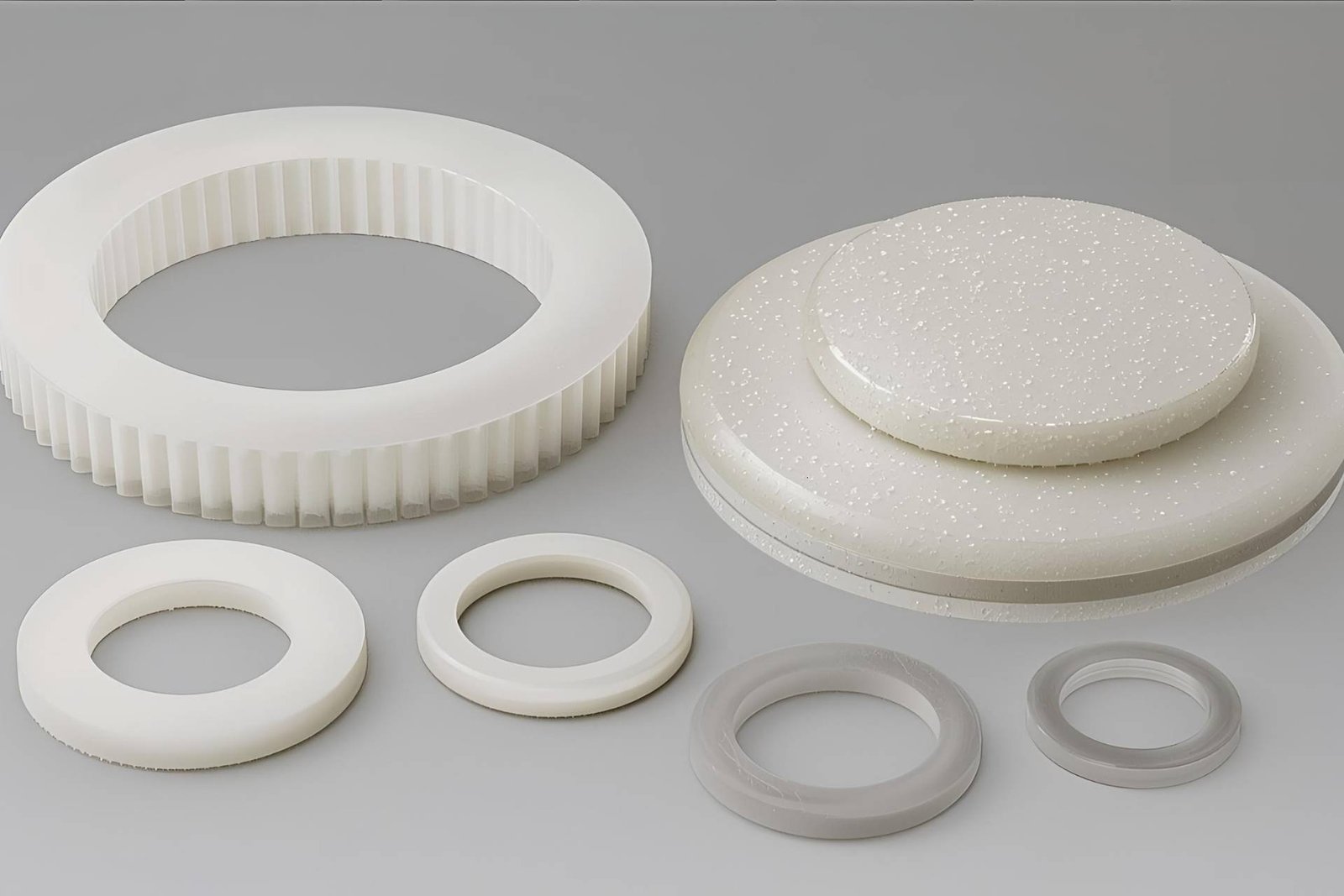
A PTFE washer is a flat, annular component molded or skived from polytetrafluoroethylene and used to distribute clamping force, isolate metals, seal against fluids, or provide a low‑friction interface. PTFE’s carbon–fluorine backbone yields exceptional chemical inertness and a low surface energy (~18 mN/m), which translates to very low static and dynamic coefficients of friction (typically 0.05–0.10 against polished steel under light load). Washers are produced as virgin PTFE or as composite grades filled with glass fiber, carbon, graphite, bronze, or mineral fillers to tune mechanical behavior.
Water absorption: <0.01% (24 h)
Dielectric strength: ~60–100 kV/mm (grade‑dependent)
Typical friction: 0.05–0.10 μ vs. steel
Material science: why PTFE behaves differently
- Non‑stick surface: the fully fluorinated chain resists adhesion, reducing galling and allowing dry‑running interfaces.
- Chemical resistance: inert to most acids, bases, solvents, and oxidizers; avoid molten alkali metals and elemental fluorine; hot concentrated alkali may cause etching over long exposure.
- Thermal behavior: glass transition around −100 °C; crystalline melt ~327 °C; practical continuous service up to 260 °C with strength derating.
- Creep (cold flow): under sustained compressive load PTFE deforms plastically; filled grades reduce creep and raise modulus by 25–200% depending on filler type and content.
- Electrical properties: high volume resistivity and low dissipation factor; useful for insulation/isolation washers in sensors and RF hardware.
Virgin vs. filled PTFE washers
| Grade | Advantages | Limitations | Typical uses |
|---|---|---|---|
| Virgin PTFE | Highest chemical purity, lowest friction, FDA suitability | Highest cold flow; lower compressive strength | Food/pharma equipment, electrical isolation, low clamp loads |
| Glass‑filled (15–25%) | Improved creep resistance and modulus; better torque retention | Can abrade mating surfaces; slightly higher friction | Valve packing glands, bolted flanges with periodic thermal cycling |
| Carbon/graphite‑filled | Enhanced wear and thermal conductivity; lower deformation | Darker color; may alter dielectric behavior | Semi‑dynamic joints, pump bases, cryogenic sliding pads |
| Bronze‑filled (40–60%) | High compressive strength, better heat dissipation | Reduced chemical resistance vs. virgin; higher density | High‑load bearings, heavy clamps with temperature cycling |
Sizing fundamentals and torque retention
For sealing or isolation duties, designers balance clamp force, contact pressure, and creep over temperature. Contact pressure P equals preload F divided by effective bearing area A. Virgin PTFE may require larger outer diameters or thicker sections to maintain P within 10–30 MPa without excessive creep. Where flange surface finish is rougher than Ra 3.2 μm, a soft intermediary (PTFE envelope over elastomer core) improves micro‑sealing.
Practical rules of thumb
- Washer thickness: 1.0–3.0 mm for M6–M16; thicker sections for electrical isolation or uneven surfaces.
- OD/ID ratio: ≥1.8 for virgin PTFE under high preload; can drop to 1.5 with filled grades or steel backup washers.
- Edge treatment: chamfer or radius to avoid extrusion lips.
Cold‑flow mitigation
- Use serrated metal washers against PTFE faces to increase friction.
- Retorque after first thermal cycle; schedule inspection after 24–48 hours.
- Consider PTFE‑bonded rubber or PTFE‑enveloped gaskets for flanges requiring elastic recovery.
Performance limits and test methods
| Property | Typical value | Reference methods | Notes |
|---|---|---|---|
| Density | 2.13–2.20 g/cm³ | ASTM D792 | Filler content increases density up to ~3.1 g/cm³ (bronze‑filled) |
| Tensile strength (virgin) | 20–35 MPa | ASTM D638 | Decreases with temperature |
| Elongation at break | 200–400% | ASTM D638 | Indicates ductility; filled grades lower |
| Hardness | Shore D 50–60 | ASTM D2240 | Filler raises hardness |
| Coefficient of friction | 0.05–0.10 (dry vs. steel) | ASTM D1894 (analogous) | Surface finish and load sensitive |
| Thermal conductivity | 0.25 W/m·K (virgin) | ASTM E1530 | Carbon/bronze fillers increase to 0.5–1.5 W/m·K |
| Max continuous service temp | ~260 °C | Manufacturer data | Short excursions higher may be tolerated |
| Volume resistivity | 10^17 Ω·cm | ASTM D257 | Useful for isolation washers |
Application domains
- Chemical process: isolation washers for glass‑lined steel and exotic alloy interfaces; resist acids, bases, halogenated solvents.
- Food and pharma: non‑stick, cleanability, and regulatory pathways for virgin grades; avoid pigments and fillers lacking compliance evidence.
- Cryogenics: low brittleness down to −196 °C; stable frictional behavior beneficial for LNG valves and cold test rigs.
- Electronics: dielectric spacers and antenna hardware; low dissipation factor reduces RF loss.
- Water treatment: isolation between dissimilar metals to limit galvanic corrosion.
PTFE washers versus alternative materials
| Material | Chemical resistance | Temperature range | Creep/elastic recovery | Friction | Notes |
|---|---|---|---|---|---|
| PTFE (virgin) | Excellent | −200 to +260 °C | High creep / low elastic recovery | Very low | Best for chemical purity and dry lubrication |
| Filled PTFE | Excellent–very good | −200 to +260 °C | Reduced creep | Low–medium | Better torque retention |
| PEEK | Very good | −50 to +250 °C | Low creep / high modulus | Medium | High strength; costlier |
| Nylon/PA | Fair (affected by moisture) | −40 to +120 °C | Medium creep | Medium | Economical isolation where chemicals are benign |
| Fibre/laminate (G10) | Good | −50 to +150 °C | Low creep | Medium | Strong electrical insulation; less chemical inertness |
| Metal (SS/Brass) | Variable | Wide | Very low creep | High | High load but no chemical isolation; may gall |
Design examples with quantitative guidance
Electrical isolation joint (M10 bolt)
- Target preload: 12–18 kN (class 8.8 bolt, 70% proof as upper bound).
- Washer: PTFE 2.0 mm thick, ID 10.5 mm, OD 22–24 mm; add stainless backup washer to reduce creep.
- Expected contact pressure: ~25–35 MPa assuming 420–450 mm² area.
Chemical flange with micro‑sealing needs
- Use PTFE‑envelope washer with elastomer core (FKM/EPDM to medium compatibility).
- Torque to gasket manufacturer’s seating stress, retorque after first heat cycle.
- Surface finish: Ra ≤3.2 μm; irregular flanges require thicker core for recovery.
Quality assurance and sourcing checklist
- Material certificates: verify resin grade and filler percentage; for regulated industries, request FDA/EU statements for contact compliance.
- Dimensional tolerances: for OD/ID ±0.2–0.3 mm typical; thickness ±0.05–0.1 mm for skived sheet, wider for molded parts.
- Surface finish: avoid tool marks or chatter that could start extrusion paths; specify deburring and edge radii.
- Lot traceability and aging: PTFE is stable; still, document production date and sintering profile for repeatability.
- Packaging: flat layered packs with interleaves to prevent warping; cleanroom bagging for sanitary uses.
For engineered sealing programs and custom washers, see SPARTA SEALING. Company profile and capabilities are outlined on the seal company page.
Illustrative images: PTFE in assembly contexts
Frequently asked questions
References and further reading
- ASTM D4894/D4895 — PTFE resin specifications: https://www.astm.org/
- ASTM F36, F38 — compressibility and creep relaxation of gasket materials: https://www.astm.org/
- FDA 21 CFR 177.1550 — perfluorocarbon resins for food contact: https://www.fda.gov/
- ISO 15527 — plastics — determination of static friction — context for tribological data: https://www.iso.org/
- NACE/AMPP corrosion control resources for bolted joints: https://www.nace.org/
This review synthesizes consensus properties and practices discussed across high‑ranking technical sources available via Google Search in 2024–2025 (materials handbooks, polymer datasheets, gasket standards). It is written originally and does not copy those sources. Links above provide standards and regulatory references for verification.