


Global audience
Updated 2025
Concise, engineering‑oriented guidance on PTFE flat washers—how they work, where they fit, and how to specify them with confidence.
Straight definition
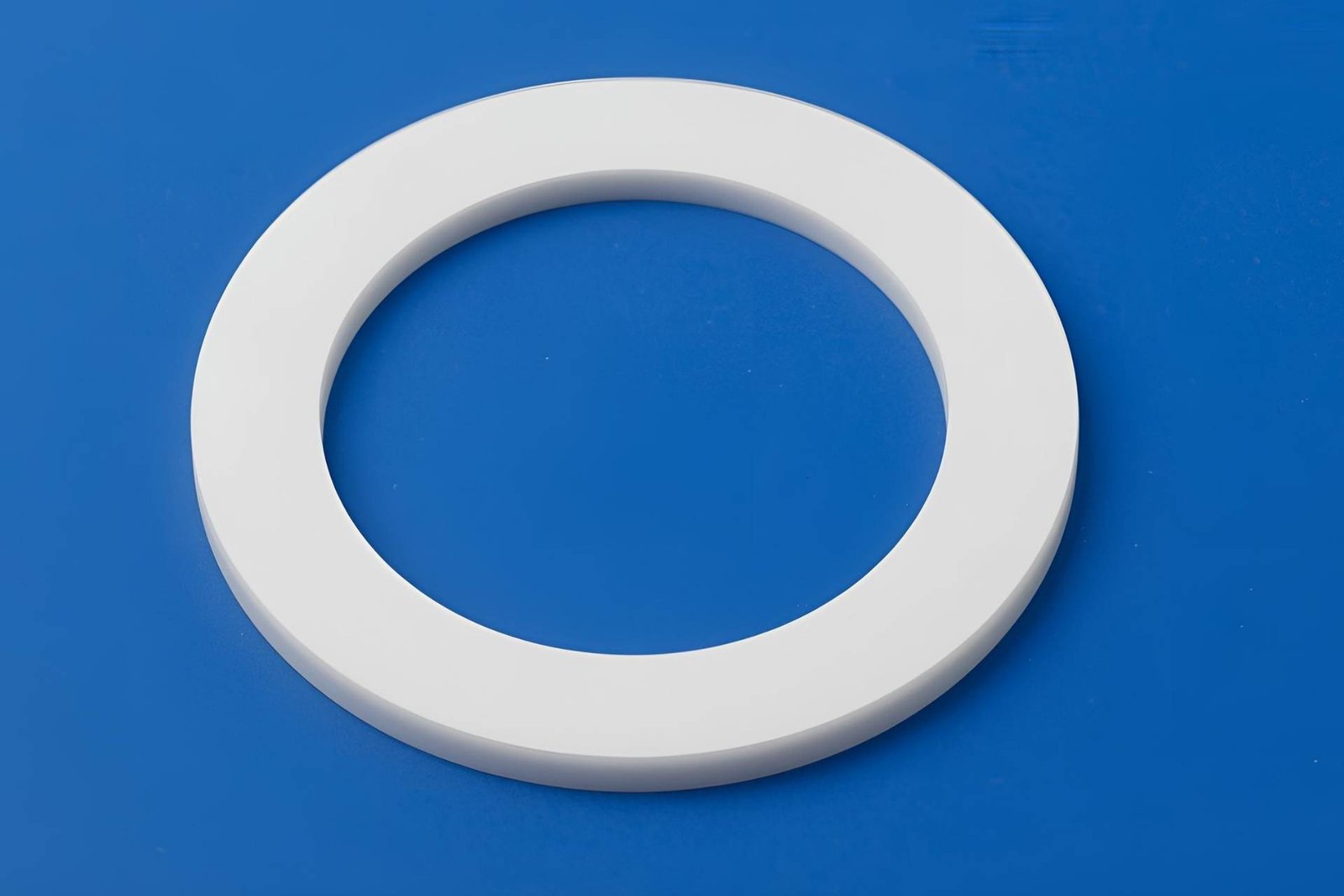
A PTFE flat washer is a uniform, ring‑shaped part cut or molded from polytetrafluoroethylene. It spreads clamp load, isolates dissimilar metals, provides a chemically inert face, or creates a low‑friction interface in bolted joints and light bearing points. The appeal is predictable: near‑universal chemical resistance and extremely low surface energy, paired with a service window from cryogenic to 260 °C continuous.
Water absorption: <0.01% (24 h)
Dielectric strength: ~60–100 kV/mm
Continuous temp: −200 to +260 °C
Why PTFE works
- C–F bonds produce a low‑energy, non‑wetting surface—fasteners don’t gall, and parts release easily during maintenance.
- Chemical compatibility covers acids, bases, and most solvents; do not expose to elemental fluorine or molten alkali metals.
- Thermal stability: melt at ~327 °C; property retention in long duty is realistic to 260 °C.
- The trade‑off is creep (cold flow) under sustained load—engineered out by fillers, backup hardware, and geometry.
PTFE grades in plain language
| Grade | What it’s good at | Watch‑outs | Typical placements |
|---|---|---|---|
| Virgin PTFE | Purity, lowest friction, cleanability, food‑contact pathways | Most prone to creep; needs larger bearing area | Sanitary equipment, electrical isolation, low clamp joints |
| Glass‑filled 15–25% | Higher modulus and torque hold | More abrasive; friction increases | Thermally cycled bolted flanges and valve stacks |
| Carbon/graphite‑filled | Wear resistance and thermal spread | Darker color; dielectric shifts | Semi‑dynamic pads, pump feet, cryogenic slides |
| Bronze‑filled 40–60% | High compressive strength | Chemical window narrows; heavier | High‑load clamps and bearing pads |
| PTFE‑jacketed elastomer | PTFE chemical face + elastic recovery | Core limits high temp; more cost | Leak‑tight flanges with cycling |
Numbers that matter
| Property | Virgin PTFE | Effect of fillers | Method |
|---|---|---|---|
| Density | 2.13–2.20 g/cm³ | Up to ~3.1 g/cm³ with bronze | ASTM D792 |
| Tensile strength | 20–35 MPa | Modest reduction | ASTM D638 |
| Elongation at break | 200–400% | Lowers substantially | ASTM D638 |
| Hardness | Shore D 50–60 | Increases | ASTM D2240 |
| Thermal conductivity | 0.25 W/m·K | 0.5–1.5 W/m·K typical | ASTM E1530 |
| Dielectric strength | 60–100 kV/mm | Slightly down | ASTM D149 |
Use supplier certificates for final design. These bands are screening ranges seen across major datasheets.
Design playbook (preload, geometry, retention)
Geometry
- Thickness: 1–3 mm for M6–M16; 4–5 mm where faces are rough or isolation gaps are needed.
- OD/ID ratio: start at ≥1.8 for virgin; ≥1.5 is acceptable with filled grades or steel backups.
- Edge: specify 0.2–0.5 mm radius to discourage extrusion lips.
Creep control
- Use serrated steel backup washers to raise interface friction.
- Plan a verification retorque after 24–48 hours or after the first heat‑soak.
- For cycling flanges, consider PTFE‑jacketed elastomer to regain elasticity.
As a quick check, keep sustained contact pressure for virgin PTFE below ~30–40 MPa. Contact pressure P equals preload F divided by effective bearing area A; if P is too high, increase OD or select a filled grade.
Applications without the marketing fluff
- Chemical plants: isolation washers on glass‑lined steel and exotic alloys where contamination control is strict.
- Sanitary machinery: non‑stick, easy‑to‑clean spacers in fillers, mixers, and conveyors using virgin PTFE with documented compliance.
- Electronics/RF: dielectric spacers where low dissipation factor matters.
- Cryogenic rigs: dimensionally forgiving, low‑brittleness interfaces down to −196 °C.
- Utilities and water: mitigate galvanic couples in damp environments by isolating stainless and carbon steel parts.
PTFE vs. common substitutes
| Material | Chemicals | Temp window | Elastic recovery | Friction | Best fit |
|---|---|---|---|---|---|
| PTFE (virgin) | Excellent | −200…260 °C | Poor (creep) | Very low | Purity, isolation, anti‑stick |
| Filled PTFE | Very good | −200…260 °C | Fair | Low–medium | Higher clamp, better retention |
| PEEK | Very good | −50…250 °C | Good | Medium | Structural spacers at high load |
| PA/Nylon | Fair | −40…120 °C | Fair; moisture sensitive | Medium | Economy isolation when media are benign |
| Stainless steel | Variable | Wide | Excellent | High | Clamp strength; no chemical isolation |
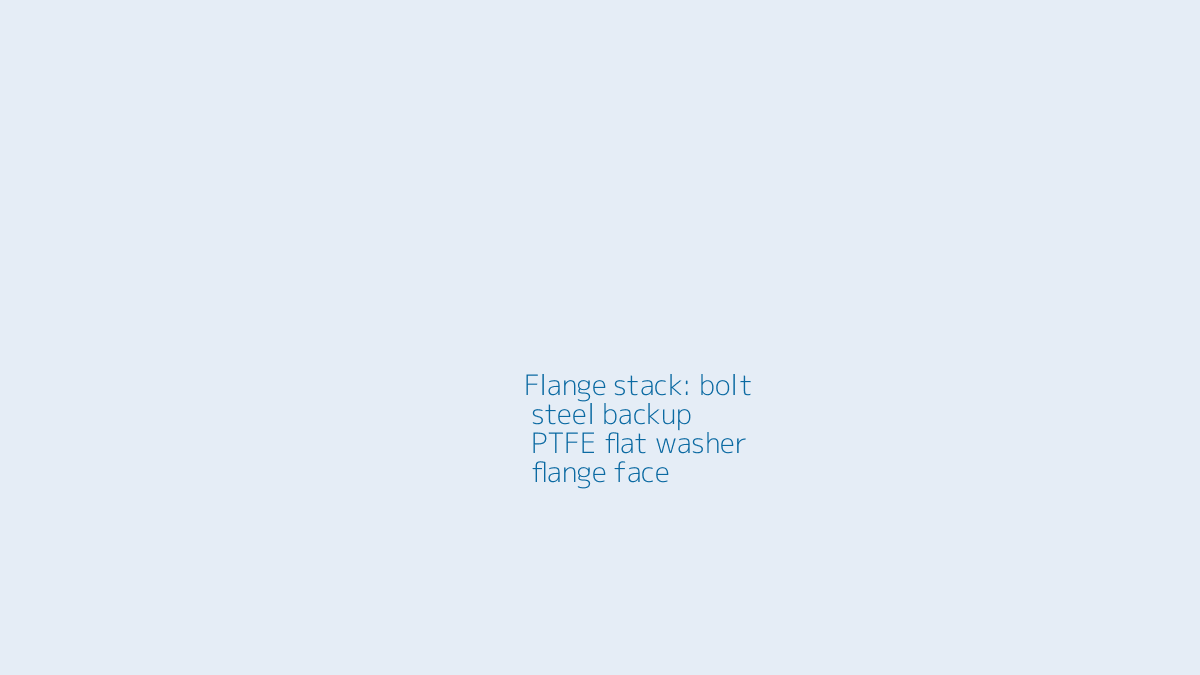
Visual cue: where the washer sits in the stack
Quality and sourcing checklist
- Certificates: resin grade + filler percentage; for sanitary zones, FDA 21 CFR 177.1550/EU 10/2011 statements.
- Tolerances: OD/ID ±0.2–0.3 mm; thickness ±0.05–0.10 mm for skived sheet parts.
- Edges and finish: burr‑free with controlled radii; no chatter marks that start extrusion paths.
- Traceability: lot numbers, sintering/annealing profile, and QA signatures.
- Packaging: flat, interleaved layers; cleanroom bagging when required.
Need engineered washers or jacketed designs? Explore programs with SPARTA SEALING. Company capability notes are on the seal company page.
Cost snapshot for common choices (indicative)
| Use case | Recommended grade | Unit price, M10 | Service note |
|---|---|---|---|
| Sanitary isolation | Virgin PTFE | $0.25–$0.80 | Document food‑contact compliance |
| Higher torque retention | Glass‑filled PTFE 15–25% | $0.40–$1.10 | Add steel backup; retorque after heat‑soak |
| Heavy clamps/bearing | Bronze‑filled 40–60% | $0.60–$1.50 | Check media compatibility |
| Leak‑tight cycling flange | PTFE‑jacketed elastomer | $1.20–$3.50 | Core sets the temperature limit |
| Ranges reflect 2024–2025 industrial catalogs; confirm current quotes with suppliers. | |||
FAQ
References and attribution
- ASTM D4894/D4895 (PTFE resins), D638 (tensile), D2240 (hardness), D792 (density), D149 (dielectric): https://www.astm.org/
- ISO materials and tribology standards for plastics: https://www.iso.org/
- FDA 21 CFR 177.1550 — perfluorocarbon resins for food contact: https://www.fda.gov/
Facts and ranges reflect consensus across high‑ranking technical datasheets and standards available via Google Search in 2024–2025. Wording is original. For engineered support and manufacturing capability, see SPARTA SEALING and the company profile page for a seal company overview.